Google has expanded its custom artificial-intelligence hardware lineup with two new tensor processing unit systems, sharpening competition in the market for processors used to train and operate increasingly complex AI models.
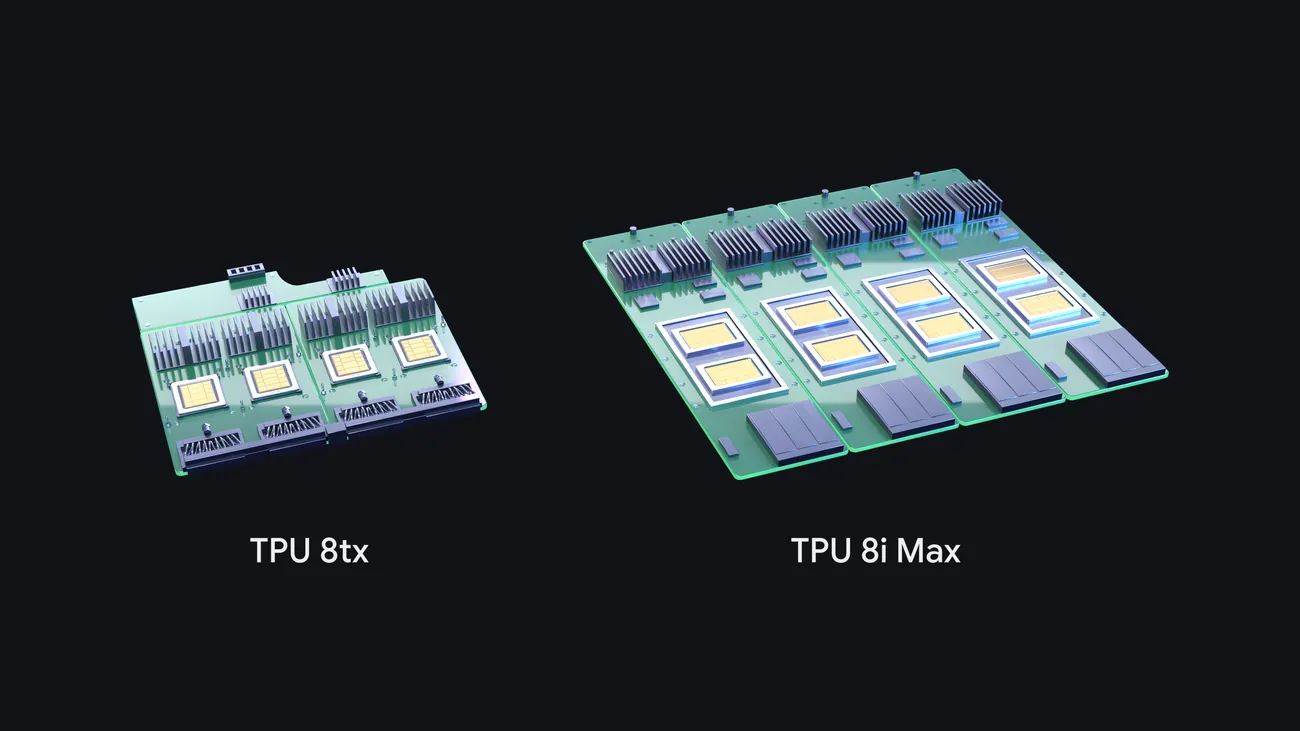
The company introduced TPU 8tx and TPU 8i Max on November 9, bringing its eighth-generation portfolio to four systems in a single year. Both are aimed at specialised demands from customers running AI agents, but they solve different technical problems.
Google says its TPU business now serves nearly 100 customers, including AI laboratories, financial firms, retailers and universities. The company is also widening the ways clients can use its chips, from renting computing capacity through Google Cloud to deploying TPU systems in their own data centres.
One system built around confidentiality
TPU 8tx is designed for businesses and public institutions that need to run sensitive data through AI systems without exposing it unnecessarily during processing.
Data is routinely encrypted while stored or moving across networks, but protecting it while a processor actively works on it is more complicated. Google says 8tx combines its accelerator technology with fifth-generation AMD EPYC host processors and confidential-computing protections intended to isolate data and model parameters during use.
That makes the system potentially relevant to banking, healthcare, government services and enterprises developing AI assistants that handle private information. However, organisations would still need to assess their overall security architecture, permissions and legal responsibilities. Hardware protection does not replace secure software design.
Google also claims 8tx delivers up to twice the latency performance of its earlier TPU 8t configuration with little additional performance cost. Those are vendor benchmarks, not an independently verified guarantee for every application.
More memory for agents with huge contexts
The second system, TPU 8i Max, tackles a different bottleneck. AI models that process lengthy documents, video archives or large software repositories need significant memory bandwidth as well as computing power.
Google says the new system packages two 8i chips together, doubling compute capacity, SRAM and high-bandwidth-memory throughput relative to a single 8i. More processing capacity in an existing rack footprint could help cloud providers serve bigger workloads without expanding floor space at the same rate.
The company points to agentic coding, research and applications requiring very long context windows as examples. But practical benefits depend on the model, software and network configuration. Higher chip specifications do not automatically translate into a proportional improvement in customer productivity.
Google wants developers beyond its own AI teams
A major challenge for custom accelerators is software compatibility. Nvidia's GPUs have a broad developer ecosystem, and shifting workloads to another kind of processor can require engineering effort.
Google is attempting to reduce that barrier through TorchTPU, its work on PyTorch compatibility, and support for widely used open-source inference tools. The company also announced software designed to suspend idle AI-agent sessions so customers do not pay for computing resources while agents wait for external tools or human input.
Google argues that customers increasingly need complete systems combining processors, memory, networking and software rather than faster individual chips alone. That reflects the economics of large-scale AI infrastructure, where electricity, utilisation and delays between components can influence the cost of serving each request.
What this means for the chip market
The announcement adds another competitive option for businesses weighing Nvidia GPUs, AMD accelerators and cloud providers' proprietary chips. It does not mean customers can switch platforms without testing performance, price and compatibility.
Google Cloud's growth gives the company an incentive to design hardware around customer workloads and keep more value inside its own infrastructure business. For customers, a wider choice of accelerators could improve bargaining power, although real savings must be evaluated using total operating costs.
The next measure of success will be adoption by outside developers and enterprises, not the launch specifications alone.